No products in the cart.


Jakub, 24.07.2026
When does a child start walking? A complete guide for parents
A child’s first steps are one of the most anticipated moments for parents. The world opens up before the little one, and every corner of the house demands exploration. When does a child start walking? Most toddlers take their first independent steps between 10 and 18 months, but the journey begins much earlier – from lifting their head, through crawling, to pulling up on furniture.
At what age does a child take their first steps?
There is no single rigid standard. According to the World Health Organization (WHO), most children achieve independent walking between 8 and 18 months, most commonly around 12-14 months. Some little ones start earlier – as early as 9 months – while others need more time and take their first steps only after 15 or 16 months.
Interestingly, prematurity does not always mean a delay. Children born early often catch up on motor development at their own pace, and pediatricians use corrected age in their case.
Age norms for first steps:
- 8-9 months: rare, but some children are early movers
- 10-12 months: the most common period, about 50% of children
- 13-15 months: completely normal pace
- 16-18 months: still within the norm, no cause for concern
- After 18 months: worth consulting a pediatrician or children’s physiotherapist
Remember, every child develops at their own pace. Comparing to friends’ children or siblings rarely makes sense – some little ones master speech first, others focus on motor skills.
Stages of learning to walk – from crawling to independent gait
Learning to walk is not a one-time achievement but a process spread over several months. Understanding the individual stages helps parents calmly observe their child’s development without putting pressure on them.
1. Lifting the head and turning (0-4 months). Strengthening the neck and back muscles is the foundation. The baby learns to control their head, turn to the sides, and gradually builds the strength needed for the next stages.
2. Sitting and creeping (4-8 months). When the little one can sit without support, their spine and abdominal muscles are ready for more. Creeping often appears – on the belly, on all fours, or in a “commando crawl” using just their arms.
3. Crawling (7-10 months). This is a key stage. Crawling strengthens the arm, hip, and torso muscles, teaches motor coordination and binocular vision. Children who crawl intensively often transition more smoothly to the next phases.
4. Pulling up on furniture (9-12 months). The little one pulls up on the sofa, crib, or table. At first they stand unsteadily, but gain confidence with each day. This is when comfortable, non-restrictive clothing matters – soft leggings and cotton trousers from Meadow’s Tale are ideal.
5. Cruising along furniture (10-13 months). The child moves sideways, holding onto furniture. This is called cruising. During this period, little ones need lots of freedom – loose, breathable t-shirts and sweaters won’t restrict them.
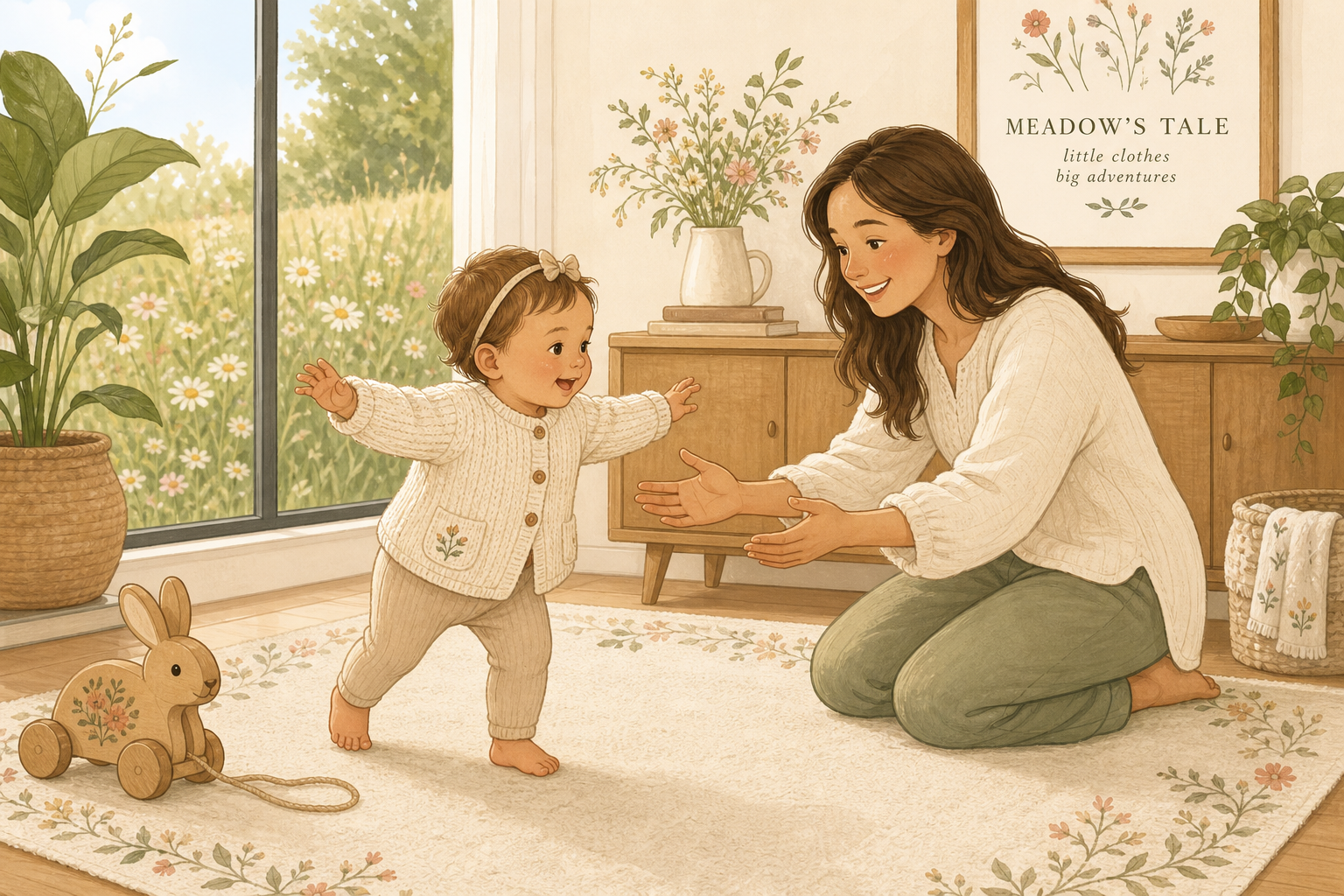
6. First independent steps (11-15 months). This moment stays in memory forever. Wobbly, uncertain, but their own. The child lets go of the furniture and takes 2-3 steps. They fall, get up, and try again. This takes enormous courage!
7. Walking freely (13-18 months). When the little one walks confidently around the house, a new adventure begins: bending down for toys, climbing over low obstacles, and soon – running.
How to support your child in learning to walk?
You don’t need to buy walkers or specialized equipment. Quite the opposite – walkers are discouraged by physiotherapists because they force the child into an unnatural position and can delay proper gait development.
What really helps:
- Give your child floor space. A mat, blanket, carpet – the more freedom, the better. Avoid long periods in car seats and carriers.
- Let your child walk barefoot. A bare foot best feels the ground, exercises muscles, and learns balance. Outdoors, soft shoes made from natural materials that don’t restrict the foot are perfect.
- Don’t rush. Each child has their own pace. Encourage with a toy placed a meter away, but don’t force walking when the little one isn’t ready.
- Ensure a safe space. Secure sharp corners, lock cabinets with chemicals, remove slippery rugs.
- Reward with smiles and applause. A parent’s emotions are the greatest motivation for a child.
What to dress your child in when they start walking?
When a child enters the phase of intense movement, clothing takes on a completely new meaning. It’s no longer just about comfort during lying or sitting – now freedom of movement, fabric elasticity, and safety matter.
Choose elastic, soft leggings that don’t slip during intense movement. A light cotton sweater works better than a thick fleece since moving children warm up quickly. Trousers should be soft cotton without rigid seams. And handmade baby shoes from Meadow’s Tale are made from the highest quality materials, designed to support the natural development of little feet.
Why isn’t my child walking yet? When to worry?
This question is asked by many parents, especially when a friend’s child of the same age is already running while their little one is still crawling. In most cases, there’s no cause for concern – developmental norms are broad.
When to consult a specialist: if the child isn’t crawling or trying to pull up after 12 months, isn’t taking independent steps after 18 months, shows asymmetry in movements, walks on tiptoes for an extended period, or if the parent has a worrying feeling – parental intuition is important.
Frequently Asked Questions
Do walkers help with learning to walk? No. Walkers are actually discouraged by specialists. They place the child in an unnatural position, relieve the hips that should be working, and can lead to incorrect gait patterns.
Does a child have to crawl to learn to walk? Not every child crawls, but crawling is a very valuable stage – it strengthens muscles, teaches coordination and alternating movements. If a child skips crawling, encourage tummy time and all-fours play.
When to buy first shoes? Only when the child walks outdoors. At home, barefoot is best – natural stimulation for developing feet.
A child’s first steps are a magical time. Each little one has their own pace and their own story, and the parent’s role is to be close – with an outstretched hand, a smile, and a bit of patience.
Also read: Riddles for 3-year-olds – support your child’s speech development through word play.
From this story
Wybierz lekkie buciki i miękkie warstwy, które nie ograniczają ruchu dziecka.

Getry merino - migdałowe
70,00 zł
Getry merino — miękkie, z szelkami, nie zsuwają się podczas noszenia